You face an IT dilemma. Your team is stretched thin. Projects are piling up. Legacy systems threaten uptime and productivity. Easy access to contractors may seem like the fastest fix but have you considered the long‑term cost of relying on that route?
This blog explores the contrast between staff augmentation and managed services. Along the way, you’ll learn how to:
Reduce IT costs through smarter resource allocation
Free your internal team to focus on strategic initiatives
Scale operations in a controlled, sustainable way
By the end, you’ll have a clear framework for choosing the right IT path, whether augmentation, managed services, or a hybrid approach.
Upgrade Your IT Operations Without Overhead!
Discover how managed services can transform costs, efficiency, and scalability.Learn More
How Staff Augmentation vs Managed Services Impacts IT Costs
When comparing staff augmentation and managed services, the biggest difference lies in how costs are structured. Staff augmentation typically uses hourly or daily rates. You pay for resource availability, not for outcomes. Managed services, by contrast, tie pricing to service levels or business results, shifting accountability to the provider.
Annual expenses for staff augmentation typically fall between $120,000 and $300,000+. At first glance, staff augmentation may look cheaper. But over time, hidden costs creep in: contractors embed themselves in your operations, accrue critical knowledge, and manage key workflows. When they leave, you face uptime risks and knowledge gaps that drive up costs you didn’t plan for.
Managed services, on the other hand, offer predictable budgeting. With providers accountable for outcomes, you know exactly what you’re paying for. Risk shifts away from your internal team, and when done right, operating costs can be capped while surprises are reduced.
Think of the comparison this way:
Staff Augmentation → You pay for hours worked
Managed Services → You pay for deliverables and outcomes
This clarity of service levels and cost makes managed services particularly appealing for organizations seeking stability and long-term efficiency.
Map your annual IT support budget. Separate fixed vs variable cost lines. Then evaluate how a shift from hourly‑based support to outcome‑based support could reduce your cost variability and risk exposure.
Flexibility and Scalability in Staff Augmentation vs Managed Services
When projects are short term or require a specialized skill set for just a week or a month, staff augmentation is the clear winner. You can scale up quickly, bring in a temporary specialist, and disengage once the work is complete. This model provides flexibility and short‑term agility without long‑term commitments.
By contrast, managed services are designed for ongoing operational capabilities such as network monitoring, cloud management, or full‑time IT support. Instead of simply adding hours, the service model scales up or down based on outcomes. This avoids the constant hiring and disengagement cycles that come with augmentation.
The trade‑off between the two models comes down to operational control versus service maturity:
Staff Augmentation → You retain direct control over day‑to‑day tasks, timelines, and priorities.
Managed Services → You yield some control in exchange for vendor processes, tools, and accountability.
To illustrate:
Scenario 1: Your manufacturing line needs extra DevOps support for six weeks — staff augmentation provides the agility you need.
Scenario 2: Your operations run 24/7 and require predictable support with documented processes — managed services deliver the stability and scalability required.
This naturally leads into the next consideration: how knowledge and oversight differ between the two models, and how that impacts long‑term resilience.
Control, Oversight, and Knowledge Management
With staff augmentation, you retain full project control. You manage tasks, team members, and deliverables directly. While this level of oversight sounds appealing, it comes with risks: contractors may leave with critical insights, documentation may lag, and your organization can become dependent on individuals rather than processes.
By contrast, managed services emphasize structure and stability. Providers enforce documentation, maintain process rigor, and commit to service levels. They handle knowledge transfer, training, and handoffs, ensuring that expertise is embedded in systems rather than tied to individuals. This creates long‑term resilience and reduces the risk of knowledge loss.
The difference becomes clear when you look at oversight and governance:
Staff Augmentation → Control remains internal, but risks include knowledge gaps and contractor dependency.
Managed Services → Providers own processes, enforce metrics, and deliver stability through documented workflows.
Strong oversight also helps prevent runaway contractor head‑count creep. Leaning too heavily on augmentation can lead to unplanned growth in outsourced staff and escalating costs, undermining governance and destroying value.
Audit your current external staffing spend. Count how many contractors you have, how long they’ve been engaged, and what outcomes they deliver. If you cannot clearly tie their work to business value, you may be leaning too far into staff augmentation instead of managed services.
Operational Performance and Productivity Differences
The core distinction between staff augmentation and managed services often comes down to input vs output. With staff augmentation, you pay for input (hours worked). That leaves your team responsible for managing workflows, which can lead to inconsistent productivity, unclear responsibilities, and variable performance.
By contrast, managed services focus on output commitments. Providers guarantee service levels, response times, and uptime targets. They assume delivery risk, giving you measurable performance metrics and predictable outcomes.
Key differences include:
Staff Augmentation → Pays for hours worked; productivity depends on your internal oversight.
Managed Services → Pays for deliverables; provider owns risk and enforces performance metrics.
Tools and processes → Managed services bring remote monitoring, automation, and standardized workflows, driving faster resolution, less downtime, and fewer repeat incidents.
Impact on teams → Internal staff spend less time firefighting and more time on innovation.
Set baseline performance metrics for your IT operations. For example, mean resolution time, number of recurring incidents, and user satisfaction. Then simulate how a shift to a managed‑services model might reduce those numbers and improve overall productivity.
Security and Compliance Considerations
When choosing between staff augmentation and managed services, security and compliance risks must be at the front of mind. A contractor may bring deep technical skill, but oversight, access policies, documentation, and controls remain your responsibility. That exposes your organization to risk if governance is not airtight.
By contrast, managed services providers specialize in delivering secure operations. They bring structured processes and advanced tools such as:
AI‑driven monitoring for real‑time threat detection
Patch management to keep systems updated and resilient
Audit trails that support compliance and accountability
Integration with compliance frameworks like HIPAA, GDPR, or industry‑specific standards
This shifts part of the burden away from your internal team and ensures that security is embedded into daily operations.
List your regulatory requirements (HIPAA, GDPR, industry‑specific). Then evaluate whether your current external staffing model meets them. If not, you likely need the structured environment of managed services to ensure compliance and reduce risk exposure.
When Staff Augmentation Makes Sense
Staff augmentation is the right move when your business faces short‑term demands, burst workloads, or requires specialized skills that aren’t needed long term. In these scenarios, contractors provide agility without locking you into extended commitments:
Niche skill requirement: For example, an Azure migration project where ongoing support isn’t necessary.
Strong internal IT team: You simply need extra hands to execute under existing processes.
Direct control over delivery: Internal partnerships or governance demand that you retain oversight of schedules and deliverables.
In these cases, you pay for contractor services, maintain control, and disengage once the project ends. This avoids committing to a long‑term outsourcing contract when your need is finite.
When Managed Services Make Sense
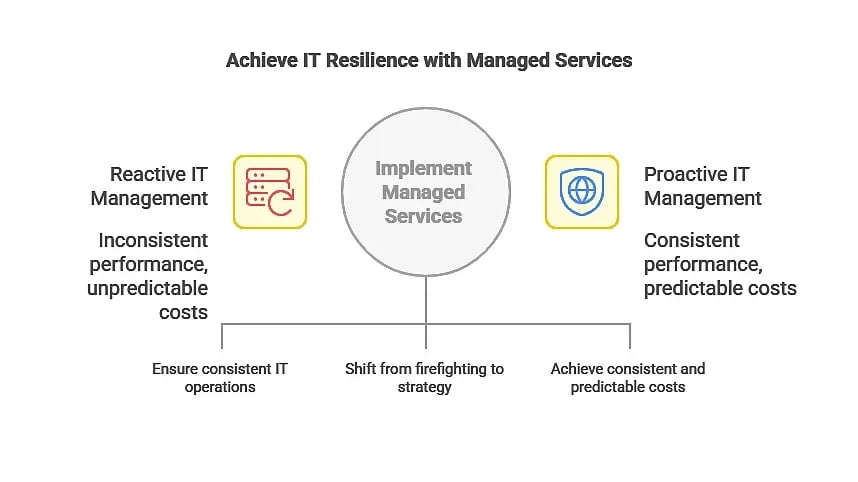
Managed services are ideal when your business requires continuous IT operations, consistent performance, and predictable costs. Instead of firefighting, you shift toward strategy and long‑term resilience.
Typical situations include:
Ongoing needs: Network monitoring, endpoint security, and cloud administration.
Strategic focus: Freeing your internal team to drive growth initiatives rather than maintain services.
In these cases, you engage a partner that delivers outcomes and assumes operational risk. You gain visibility, stability, and accountability — aligning with a business‑executive mindset where your team focuses on growth while the provider focuses on delivery.
Merging Managed Services and Staff Augmentation
It’s not always a matter of choosing one or the other. In fact, the most effective IT strategies often combine both models. Managed services provide stability for core operations, while staff augmentation delivers agility for special projects. Together, they create a balance of flexibility and long‑term reliability.
For example, imagine your IT environment is managed by a provider who oversees infrastructure, monitoring, and security. At the same time, you launch a short‑term cloud analytics initiative. By bringing in augmentation resources for six months, you complete the project without disrupting your core service model.
Once the initiative ends, you disengage the contractors while your managed services provider continues to ensure uptime and compliance.
This hybrid model gives you the best of both worlds:
Avoid runaway contractor costs in core operations
Retain flexibility for project‑based work
Ensure long‑term stability through structured service delivery
Key Takeaways for Decision‑Makers
Let’s recap the differences between staff augmentation and managed services:
Staff augmentation vs managed services → Hours vs outcomes
Cost → Augmentation seems cheaper short term but risks long‑term cost creep; managed services provide predictability
Flexibility → Augmentation gives rapid scale; managed services scale based on service demands
Control → Augmentation keeps control with you; managed services shift risk to the provider while adding process discipline
Security & compliance → Managed services often provide stronger structured support
Right model → Use augmentation for project bursts; use managed services for ongoing support
Create a decision matrix. List your needs, control preference, cost tolerance, and strategic timeline. Map each need to “augmentation,” “managed services,” or “hybrid.” Then run a pilot with your chosen model to validate outcomes before scaling.